apple Ai
For years, Siri has been the punchline of AI conversations.
While ChatGPT, Gemini, Claude, and Copilot evolved into powerful AI assistants capable of writing emails, analyzing documents, and holding human-like conversations, Siri remained stuck setting alarms and answering simple questions.
That may finally be about to change.
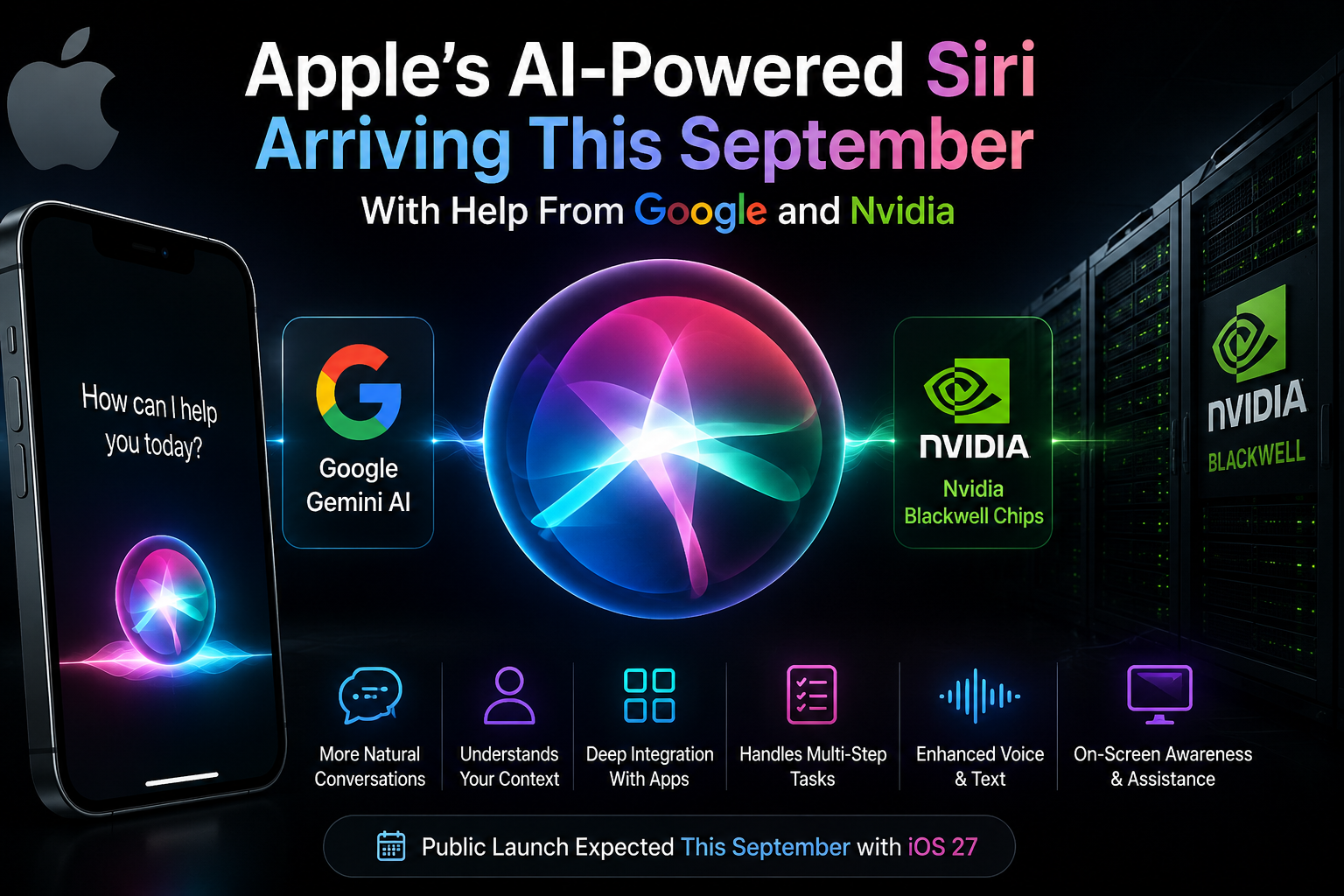
According to multiple reports, Apple is preparing to launch a completely rebuilt version of Siri in September 2026 alongside iOS 27. But the most surprising part isn’t the launch itself—it’s who is helping Apple make it happen. Instead of relying solely on its own technology, Apple is reportedly turning to Google’s Gemini AI and Nvidia’s cutting-edge AI chips to power the biggest Siri upgrade in the assistant’s 15-year history.
Why This Matters More Than Another iPhone Launch
Apple has always been known for controlling every part of its ecosystem. From designing its own chips to building its own software, the company rarely depends on rivals.
That’s why this move is so significant.
Reports suggest that complex Siri requests will be handled by a customized version of Google’s Gemini AI running on Nvidia Blackwell processors inside Google Cloud infrastructure. Simpler tasks such as setting reminders, sending messages, or changing settings will continue to run directly on Apple devices.
In simple terms, Apple is building a hybrid AI system where your iPhone handles basic tasks while Google’s AI tackles the heavy thinking.
Siri Could Finally Become a Real AI Assistant
The new Siri is expected to be far more intelligent than anything Apple has released before.
Imagine asking Siri:
“Find the email my manager sent last week about the project, summarize it, create a task list, and add the deadlines to my calendar.”
Instead of responding with confusion, the upgraded Siri may actually complete the entire task.
Reports indicate the new assistant will understand context, remember previous conversations, work across multiple apps, and handle complex multi-step requests. It could feel less like a voice command tool and more like a true AI companion.
The Real Reason Apple Needed Google and Nvidia
Apple’s AI ambitions have hit several roadblocks over the last two years.
The company originally planned to power many of its AI features using its own infrastructure. However, reports indicate that Apple’s internal systems struggled to deliver the speed and performance required for large AI models. As a result, Apple reportedly turned to Google Cloud and Nvidia’s Blackwell AI chips to accelerate development and deliver a competitive product.
This is a rare admission that even Apple cannot win the AI race alone.
Privacy Still Remains Apple’s Biggest Challenge
Whenever cloud-based AI is involved, privacy becomes a major concern.
To address this, Apple is reportedly using Nvidia’s Confidential Computing technology, which encrypts user data while it is being processed in the cloud. Apple is expected to continue emphasizing privacy as a key part of its AI strategy, even when some requests are handled outside the device.
September Could Change Apple’s Future
The upcoming Siri launch is about much more than a voice assistant.
This is Apple’s opportunity to prove it can compete in the AI era. After watching rivals dominate headlines with advanced AI products, the company now faces pressure to deliver an assistant that feels modern, useful, and genuinely intelligent.
If Apple succeeds, Siri could become one of the most powerful AI assistants in the world. If it fails, the company risks falling even further behind in the most important technology race of this decade.
One thing is certain: September 2026 could be remembered as the moment Siri finally grew up.
About the Author