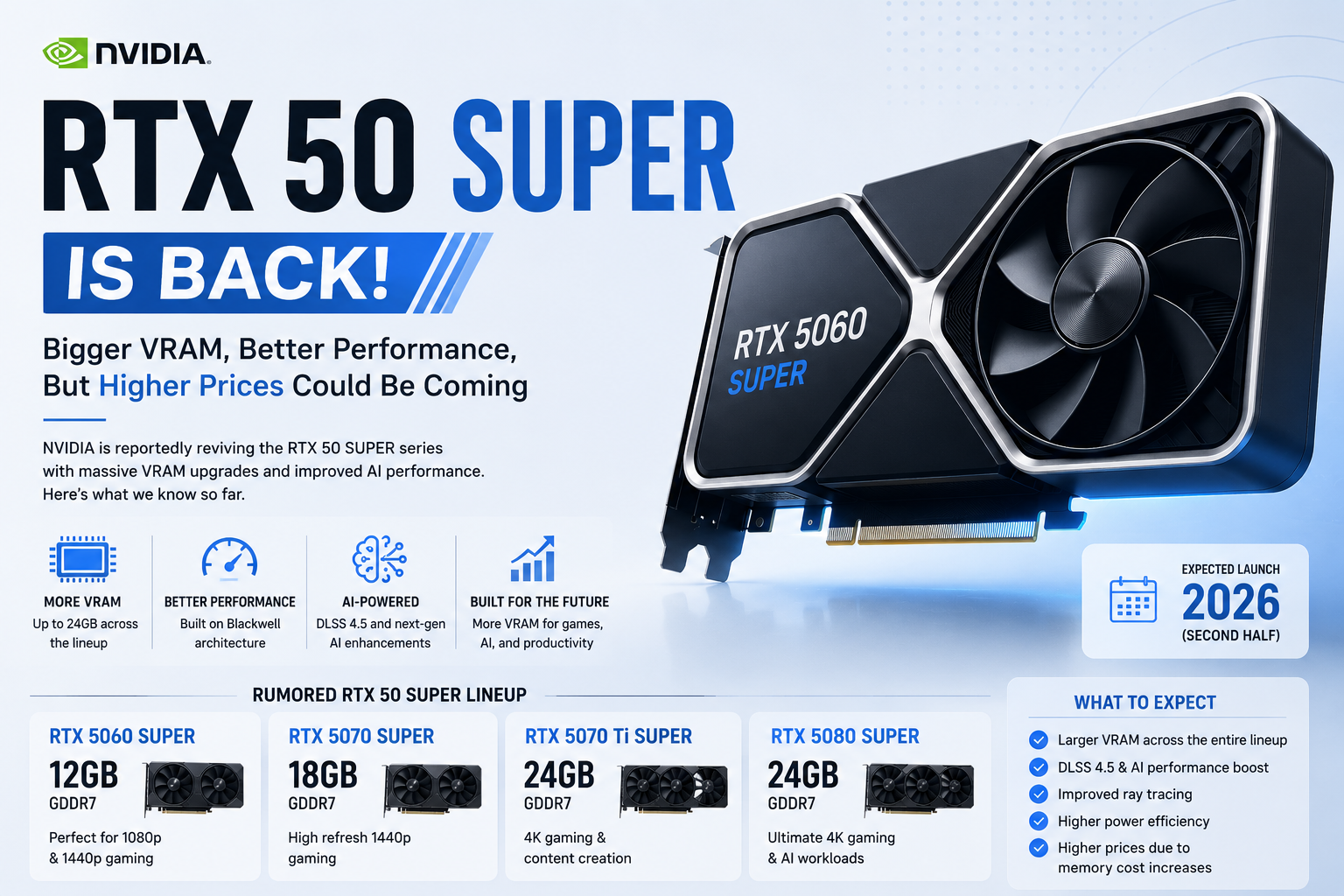
The NVIDIA RTX 50 SUPER series may be making a comeback, and if recent leaks are accurate, it could become one of the most significant graphics card refreshes in years.
After months of rumors suggesting NVIDIA had delayed or even canceled its SUPER refresh plans due to memory supply constraints, new reports indicate the company is actively working on updated Blackwell-based GPUs featuring larger VRAM capacities and improved performance. For gamers, content creators, and AI enthusiasts, this could be exactly the upgrade they’ve been waiting for.
Most notably, industry insiders claim NVIDIA is testing an RTX 5060 SUPER with 12GB of GDDR7 memory, potentially addressing one of the biggest complaints surrounding modern graphics cards: insufficient VRAM.
RTX 50 SUPER Is Reportedly Back on NVIDIA’s Roadmap
The journey of the RTX 50 SUPER lineup has been far from straightforward.
Earlier rumors suggested NVIDIA had shifted its focus toward AI accelerators and data center products, causing delays to its gaming GPU roadmap. At the same time, global shortages of advanced memory technologies such as GDDR7 and HBM raised concerns about whether a SUPER refresh would happen at all.
However, the latest reports suggest the project is once again moving forward. While NVIDIA has not officially announced any RTX 50 SUPER models, multiple sources indicate the company is evaluating refreshed versions of several RTX 50-series GPUs for a possible 2026 launch.
If true, this would continue NVIDIA’s long-standing strategy of releasing mid-generation “SUPER” upgrades that enhance specifications without requiring an entirely new architecture.
Why VRAM Has Become the Most Important GPU Specification
For years, gamers focused primarily on GPU core counts and clock speeds. Today, VRAM capacity has become equally important.
Modern AAA games are more demanding than ever, utilizing:
- Ultra-high-resolution textures
- Real-time ray tracing
- Path tracing technologies
- AI-enhanced rendering
- Massive open-world environments
As graphics fidelity continues to improve, many games can easily exceed 8GB of VRAM usage at 1440p and 4K resolutions.
The growing popularity of AI applications has accelerated this trend even further. Whether you’re running local AI models, generating images, editing videos, or working with 3D content, larger memory capacities can dramatically improve performance and usability.
This is why the rumored VRAM upgrades across the RTX 50 SUPER lineup have generated so much excitement.
RTX 5060 SUPER 12GB Could Be the Standout GPU
Among all the rumors, the RTX 5060 SUPER is attracting the most attention.
According to recent leaks, NVIDIA is exploring a version equipped with 12GB of GDDR7 memory. This would be a major improvement over traditional 8GB configurations that many gamers have criticized for lacking long-term viability.
A 12GB RTX 5060 SUPER could deliver several key advantages:
Better 1440p Gaming Performance
As newer games continue demanding more memory, additional VRAM can help eliminate texture pop-in, reduce stuttering, and improve overall frame consistency.
Stronger AI Capabilities
AI workloads benefit heavily from larger memory buffers. Users working with local LLMs, image generation tools, and machine learning projects would gain significantly more flexibility.
Longer Upgrade Lifespan
Many gamers now keep their graphics cards for five years or longer. A larger VRAM pool makes the GPU more future-proof and capable of handling next-generation titles.
Improved Value for Creators
Video editors, streamers, designers, and 3D artists often see greater benefits from memory upgrades than modest increases in processing power alone.
More VRAM Could Be Coming Across the Entire SUPER Family
The RTX 5060 SUPER may not be the only card receiving a memory upgrade.
Several industry rumors suggest NVIDIA is considering larger memory configurations throughout the lineup, including:
- RTX 5070 SUPER – 18GB GDDR7
- RTX 5070 Ti SUPER – 24GB GDDR7
- RTX 5080 SUPER – 24GB GDDR7
While these specifications remain unconfirmed, they indicate a clear shift in NVIDIA’s strategy toward addressing increasing VRAM demands across gaming, content creation, and AI workloads.
Instead of focusing solely on more CUDA cores, NVIDIA appears to be prioritizing memory capacity—something many users have been requesting for years.
The Technology Making These Upgrades Possible
One reason these rumored upgrades are feasible is the introduction of new 3GB GDDR7 memory modules.
Memory manufacturers such as SK hynix are reportedly developing higher-density GDDR7 chips that allow GPU makers to increase memory capacity without redesigning existing memory buses.
This gives NVIDIA a relatively efficient way to offer significantly larger VRAM configurations while continuing to use the same Blackwell architecture and board designs.
For consumers, that means more memory without waiting for an entirely new GPU generation.
AI Is Changing the Future of Graphics Cards
The GPU market is no longer driven solely by gaming.
Today’s graphics cards are increasingly used for:
- Generative AI
- Local LLMs
- Video production
- 3D rendering
- Machine learning
- Software development
- Scientific computing
NVIDIA’s Blackwell architecture was designed with AI acceleration at its core, and technologies such as DLSS 4 continue to blur the line between gaming and AI processing.
As AI becomes a mainstream workload, larger VRAM capacities are becoming a necessity rather than a luxury.
This trend may explain why NVIDIA’s rumored SUPER refresh focuses heavily on memory upgrades instead of traditional performance increases alone.
The Bad News: Prices Could Rise
While larger VRAM capacities are exciting, they may come with a downside.
Additional GDDR7 memory increases manufacturing costs, and the global demand for advanced memory chips remains extremely high due to the rapid expansion of AI infrastructure.
As a result, industry analysts believe NVIDIA may position the RTX 50 SUPER series as a premium upgrade rather than a budget-friendly refresh.
In simple terms, gamers could finally get the VRAM they’ve been asking for—but they may have to pay considerably more to get it.
RTX 50 SUPER Release Date: When Can We Expect It?
NVIDIA has not officially announced the RTX 50 SUPER series, but current rumors point toward a launch sometime in 2026.
The exact timeline remains uncertain, and supply chain conditions could still impact release schedules. However, recent reports suggest the project is active and progressing, making a 2026 debut increasingly likely.
Until NVIDIA confirms specifications, pricing, and launch dates, all current information should be treated as rumor rather than fact.
Should You Wait for the RTX 50 SUPER Series?
If you’re currently using an RTX 30-series GPU or older hardware, the RTX 50 SUPER lineup may be worth waiting for.
The combination of:
- Larger VRAM capacities
- Blackwell architecture
- DLSS 4 technology
- Improved AI performance
- Better long-term value
could make these GPUs some of the most balanced graphics cards NVIDIA has released in recent years.
However, if you need an upgrade immediately, it may not be wise to delay your purchase solely based on leaks and speculation.
Final Thoughts
The RTX 50 SUPER series is shaping up to be much more than a routine refresh.
If current rumors prove accurate, NVIDIA may finally address one of the biggest criticisms of modern graphics cards by delivering significantly larger VRAM capacities across its gaming lineup.
For gamers, creators, and AI enthusiasts alike, the rumored RTX 5060 SUPER 12GB could become one of the most attractive mid-range GPUs of the Blackwell generation.
The only remaining question is whether NVIDIA can deliver these improvements without pushing prices beyond what mainstream buyers are willing to pay.
As we move closer to 2026, the RTX 50 SUPER series is quickly becoming one of the most anticipated GPU launches in the PC gaming industry.
About the Author